Wholesale buying
How to Read Dried Mushroom Labels and Specs in Canada
A practical guide to common name, net quantity, bilingual information, ingredients, lot codes, dates, storage, origin, and buyer specifications in Canada.
By Editorial Team
Food sourcing and kitchen operations specialists covering ingredient procurement, storage science, and commercial kitchen efficiency across Canada.
A Canadian dried mushroom buyer should read two different documents: the package label, which carries consumer and traceability information required or permitted for that product, and the supplier specification, which defines the commercial item being purchased. A compliant-looking label does not tell a chef the size distribution, broken-piece tolerance, stem content, rehydration performance, or case configuration. A detailed specification does not replace mandatory label information.
This guide offers practical purchasing context, not legal advice. Canadian requirements vary with the food, package, sales channel, business activity, province, claims, and possible exemptions. Importers, manufacturers, and sellers should confirm the current Food and Drugs Act, Food and Drug Regulations, Safe Food for Canadians Act and Regulations, and applicable provincial rules with a qualified professional.
Start with identity, net quantity, and responsible business
The common name should tell the buyer what food is in the package, while the specification should remove any remaining ambiguity. “Dried mushrooms” may be too broad for a purchasing decision even where the label context is accepted. A useful commercial description identifies the type, such as dried shiitake, dried oyster mushroom, dried black fungus, or dried cordyceps flower, and may add the scientific name in the specification.
Do not assume two trade names identify the same species. Wood ear, black fungus, cloud ear, kikurage, and mu er can overlap in the market, while suppliers may use “cloud ear” for a smaller grade. Match the common name to the ingredient list, scientific name, product photos, and sample. The CFIA’s industry overview explains which food products require a label and routes businesses to the applicable requirements and exemptions.
Net quantity states how much product is in the retail package, normally in metric units under Canadian rules. It is not the case gross weight, shipping weight, hydrated yield, or usable cooked weight. For a wholesale carton, confirm inner-pack net weight, number of inner packs, declared case net weight, and expected weight tolerances in the commercial documents.
Look for the name and principal place of business of the responsible company as required for the product. A brand name alone is not enough for supplier approval. Procurement records should also preserve the legal supplier name, ordering contact, delivery address, and complaint or recall contact.
Check language, ingredients, allergens, and nutrition information
Mandatory information on consumer prepackaged food is generally required in English and French unless a specific exemption applies. A bilingual front panel alone does not prove the rest of the package is complete. The CFIA’s bilingual food-labelling guidance explains the general rule and available exemptions. Businesses should assess the actual product and market rather than copying a competitor’s package.
For a single-ingredient package of dried mushrooms, the common name may appear straightforward. A seasoned mushroom mix, soup blend, or product with sulphites, flavouring, oil, salt, or other ingredients creates different ingredient and allergen questions. Read the ingredient list in descending order by weight where required and review priority allergens, gluten sources, and added sulphites under the applicable rules. Never assume a product is single-ingredient because mushrooms dominate the front image.
Most prepackaged foods require a Nutrition Facts table, but exemptions and loss of exemptions can depend on the product and claims. A buyer should not declare a missing table illegal from appearance alone, nor assume it is optional because the food is dried. Ask the responsible business to identify the basis for the label and obtain professional review before printing or importing packaging.
Claims need evidence and rule-specific review. “Organic,” health claims, “Product of Canada,” and “Made in Canada” are not interchangeable. Use only claims supported for the purchased SKU and retain the underlying documents.
Read lot codes, dates, and storage instructions together
A lot code connects a package to a defined production or handling lot and is essential when investigating a complaint or recall. The Canadian Food Inspection Agency describes the role and form of lot codes. Record the code at receiving; do not wait until the inner package has been discarded.
A code may look like a date, time, line code, alphanumeric string, or another identifier. Do not guess its meaning. Ask the supplier for the coding format and make sure the code on the case can be connected to the code on inner packages and invoices. Restaurants that decant product should carry the original item and lot identification onto the working container.
Best-before dates and expiration dates are not synonyms. A best-before date concerns freshness and quality of an unopened product stored as directed; an expiration date is used for certain foods with specific compositional requirements. Not every long-life dried mushroom package will display a best-before date under the same circumstances. Its absence should prompt a product-specific check, not an automatic accusation.
Read any “keep cool and dry,” refrigeration, or other storage statement together with the date. The useful life of an opened package can change after air and humidity enter. Buyers should request the supplier’s unopened storage conditions, stated shelf life, opened-package handling guidance, and policy for remaining shelf life at delivery.
Treat country, grade, and product claims carefully
A Canadian distributor address does not by itself mean the mushrooms were grown in Canada. The business named on a label may be an importer, distributor, or brand owner. Country-of-origin wording depends on the product and the claim being made, so ask directly where the mushrooms were cultivated, processed, dried, packed, and shipped from.
Keep those stages separate in the specification. “Packed in Canada,” “imported by a Canadian company,” and “Product of Canada” communicate different things. If origin is important to a tender or menu statement, require written evidence for the exact lot and have the intended claim reviewed.
Terms such as premium, small, whole, Grade A, restaurant grade, and selected are not sufficiently precise by themselves. Translate them into measurable acceptance criteria: scientific name, whole or sliced form, size range and percentage within range, cap-to-stem expectation, broken-piece limit, colour, characteristic aroma, moisture limit, foreign-material tolerance, defects, packaging, and sampling plan.
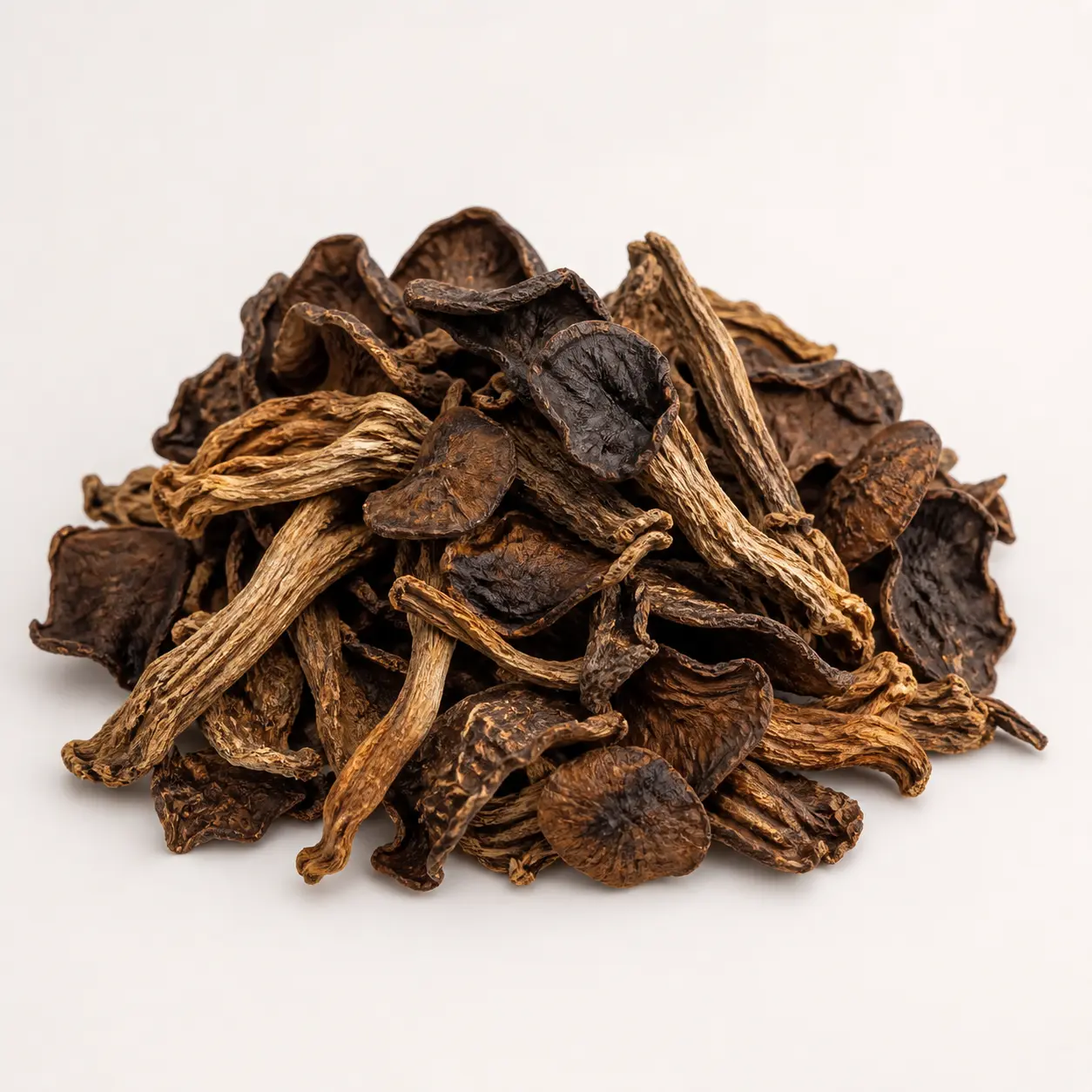
For example, the Fungi Origin black fungus product page identifies a specific commercial product, but a wholesale buyer should still request the current specification and lot details before approving a menu or private-label declaration.
Build a buyer specification beside the legal label
A purchasing specification should describe what the kitchen can accept and how both parties will verify it. Include supplier and SKU, common and scientific name, origin stages, cut, grade, size distribution, stem content, broken material, sensory standard, moisture, foreign matter, net pack, case pack, lot coding, date and storage conditions, allergen statement, certificates where required, and complaint procedure.
Add performance requirements only when the test method is written. A promise such as “high rehydration yield” is not measurable without dry sample weight, water temperature and volume, soak time, drain time, trim rules, and accepted cooked texture. Use the restaurant’s real recipe to establish a target range and keep the lot number with every test.
For private-label or imported product, assign responsibility for label creation, translation, regulatory review, artwork approval, and records. Supplier data does not transfer the importer’s legal obligations. Never print packaging from a product-page screenshot.
Use the questions to ask a dried mushroom wholesaler before approval, and review Fungi Origin wholesale rules for ordering context. Confirm current documents for the particular SKU and lot.
Use a receiving checklist for every delivery
Receiving is where label information becomes traceability evidence. Match the delivered item to the purchase order, then verify product name, supplier, lot code, date where present, net quantity and case count, package integrity, dryness, normal aroma, absence of visible pests or water damage, and required remaining shelf life.
Photograph and isolate mismatches before storage. Keep labels until traceability data is recorded, and do not merge lots. If identity, origin, ingredients, or codes differ from approved documents, pause use and ask for clarification.
Store the accepted product under the stated conditions and mark the opening date. Digital records should connect supplier, invoice, lot, quantity received, storage location, menu use, and any complaint. The best label is useful only when the business preserves and acts on its information.
Frequently asked questions
Must dried mushroom labels in Canada be bilingual?
Mandatory information on consumer prepackaged foods is generally bilingual, but exemptions can apply in defined circumstances. The answer depends on the actual product and market. Review the current CFIA guidance and obtain qualified advice before relying on an exemption.
Does a dried mushroom package need a best-before date?
Not every package has the same date-marking requirement. Product durability, packaging location, sales format, and other factors matter. A missing best-before date is not automatically proof of non-compliance; confirm the rule for the SKU and request the supplier’s shelf-life and storage documentation.
What should a restaurant request beyond the label?
Request a current product specification, scientific name, origin stages, cut and size tolerances, stem and broken-piece limits, moisture and defect criteria, case configuration, lot coding, storage and shelf-life information, allergen statement, and an agreed sample or rejection process.
Approve the label and the food as separate checks
Use the package to confirm identity, quantity, responsible business, traceability, and applicable consumer information. Use the specification and representative lot test to confirm kitchen performance. For a current specification, case format, or wholesale discussion, contact Fungi Origin with the product, sales channel, volume, and documentation you require.
Shop this product
Buy black fungus wholesale
Stocked in Ontario. Free GTA delivery over $350 CAD; courier shipping across Canada and to the US.
Wholesale
Dried Fungus
Black Fungus
Clean and well-selected dried black fungus suitable for food service and retail resale.
Wholesale price
$15.62/lb
$34.43/kg
Market reference
Approx. $59–80/kg
Need wholesale support?
Contact Fungi Origin for pricing, product inspection, pickup, GTA delivery, or courier shipping across Canada and the US for bulk dried mushroom orders.
Contact Us