Oyster Mushroom
Dried Oyster Mushrooms for Restaurants in Canada
Restaurant-grade dried oyster mushrooms — variety selection, format guidance, monthly volume planning, and wholesale pricing for Canadian foodservice.
By Editorial Team
Food sourcing and kitchen operations specialists covering ingredient procurement, storage science, and commercial kitchen efficiency across Canada.
Restaurants are the largest commercial buyer segment for dried oyster mushrooms in Canada — particularly plant-based restaurants, Asian-cuisine restaurants, and modern fusion concepts. Restaurant sourcing has specific needs that differ from retail and wholesale-club channels: variety flexibility, consistent grade specifications, monthly delivery scheduling, and pricing structured to support food cost discipline. Dried oyster mushrooms for restaurants in Canada are wholesale-tier purchases of dried Pleurotus species sized to monthly menu volume, with variety selection (pearl, king, specialty) matched to specific menu applications, format choice (whole, sliced) matched to restaurant prep workflows, and pricing structures that support 60–75% food cost margins on oyster-mushroom-featured menu items.
Match Variety Selection to Menu Applications
Restaurant variety selection should follow specific menu items rather than defaulting to one variety for everything. Different oyster mushroom varieties unlock different menu applications.
Variety-by-application guidance for restaurants:
- Pearl oyster — sautés, vegan bacon, pulled-style fillings, pasta, soups, daily workhorse
- King oyster — vegan scallops, plant-based steaks, center-of-plate main courses
- Pink oyster — visual-impact garnishes, brunch features, modern fusion plates
- Golden oyster — tasting menu accents, photogenic plate features
- Blue oyster — firmer-texture applications, specialty preparations
A typical Canadian plant-based restaurant menu featuring 4–6 oyster mushroom items spans pearl oyster (2–3 items), king oyster (1–2 items), and possibly one specialty variety for menu differentiation. Asian-cuisine restaurants typically focus more heavily on pearl oyster with occasional king oyster for premium dishes.
Choose Format Based on Prep Workflow
Restaurant format choice should match the operation's prep workflow, kitchen size, and weekly oyster mushroom usage. Different formats reduce labor differently.
Format-by-workflow guidance:
- Whole oyster mushroom — best for visible plate features and shred-and-cook applications
- Sliced oyster mushroom — saves prep time for daily sauté and stir-fry production
- Powder format — for sauce thickening, finishing dust, vegan umami applications
Most Canadian restaurants benefit from stocking both whole and sliced formats. Whole format handles featured-application uses; sliced format handles daily volume use where prep speed matters. According to a 2024 Canadian restaurant operations survey, kitchens that purchased both whole and sliced oyster mushroom formats reported 18% lower per-portion labor cost than kitchens stocking only whole format.
Plan Monthly Volume by Restaurant Type
Different restaurant concepts use oyster mushrooms at meaningfully different monthly volumes. Understanding typical patterns helps with wholesale planning and contract structuring.
Typical monthly oyster mushroom usage by restaurant type:
- Plant-based fine dining (50–100 covers/day) — 8–15kg monthly
- Plant-based casual (100–200 covers/day) — 12–25kg monthly
- Modern Asian fusion — 4–10kg monthly
- Cantonese restaurant — 3–8kg monthly
- Asian fine dining featuring vegan menu items — 6–14kg monthly
- Italian restaurant featuring oyster mushroom dishes — 2–6kg monthly
- Single-feature restaurant (one oyster dish on menu) — 1–3kg monthly
These volumes scale with menu prominence and customer adoption. Restaurants experiencing menu growth around plant-based or Asian-cuisine items should commit to monthly delivery agreements rather than spot-buying — pricing stability and inventory priority matter at any volume above 3kg per month.
Build Wholesale Pricing for Restaurant Economics
Restaurant economics require wholesale pricing that supports menu food-cost discipline. Direct-import sourcing typically delivers 30–50% better pricing than broadline distribution.
Restaurant-tier oyster mushroom pricing for direct-import:
- Pearl oyster (1–4kg orders) — CAD $65–$95/kg
- Pearl oyster (5–9kg orders) — CAD $58–$85/kg
- Pearl oyster (10kg+ orders) — CAD $50–$75/kg
- King oyster (1–4kg orders) — CAD $115–$145/kg
- King oyster (10kg+ orders) — CAD $90–$125/kg
- Specialty varieties (1kg) — CAD $100–$160/kg
- Annual contract (50kg+) — negotiated, often 10–18% better than spot
Per-portion food cost economics work well at these wholesale tiers:
- Pearl oyster sauté portion (30g dried) — CAD $1.65–$2.85 ingredient cost
- King oyster medallion portion (40g dried) — CAD $4.60–$5.80 ingredient cost
- Vegan oyster bacon portion (30g dried) — CAD $1.65–$2.85 ingredient cost
Against typical menu pricing of CAD $14–$32 for oyster-mushroom-featured items, food cost margins of 12–25% are sustainable across most applications.
Negotiate Restaurant-Specific Service Terms
Restaurant accounts benefit from service terms beyond just per-kg pricing. Smart restaurant operators negotiate the full relationship rather than focusing only on price.
Restaurant-specific service considerations:
- Monthly delivery scheduling — predictable inventory cycle
- Net 30 payment terms for established accounts
- Variety substitution flexibility — pivot between varieties as menu evolves
- Menu development support — sample shipments for new menu testing
- Multi-cluster contracts — combine oyster with shiitake, Lion's Mane, porcini
- Lead time guarantees — protection against tight-supply weeks
- Annual contract structure — pricing stability across the year
Direct importers like Fungi Origin offer restaurant accounts dedicated account management with monthly delivery scheduling, multi-cluster pricing for combined Asian and plant-based mushroom orders, and menu development consultation for new oyster-mushroom-featured items.
Frequently Asked Questions
What's the best variety of oyster mushroom for restaurant use?
It depends on menu applications. For plant-based restaurants featuring vegan scallops and steak preparations, king oyster is essential. For daily volume uses (sautés, vegan bacon, pasta), pearl oyster is the workhorse. Most Canadian restaurants serving substantial oyster mushroom programs stock both pearl and king. Specialty varieties (pink, golden) are useful for menu differentiation but not core inventory.
How much should a Canadian restaurant pay per kilogram for dried oyster mushrooms?
Direct-import wholesale pricing for restaurant-tier purchasing of pearl oyster Grade A whole runs CAD $50–$95/kg depending on volume; king oyster runs CAD $90–$145/kg. Pricing through distributors or broadline foodservice typically runs 25–45% above these direct-import ranges. For any restaurant using more than 3kg/month, direct-import sourcing makes economic sense.
Can a restaurant request specific cultivation method or origin for oyster mushrooms?
Yes, established restaurant accounts can request specific cultivation methods (substrate-grown vs. log-grown) and origin specifications (Chinese, Korean, Japanese cultivation). For most culinary applications the differences are modest, and origin specifications are more relevant for premium or fine-dining accounts where menu storytelling matters. Lead times for custom-spec orders typically run 2–6 weeks; standard graded inventory ships same-week.
Build Your Restaurant Oyster Mushroom Program
Variety selection matched to menu applications, format choice matched to prep workflow, monthly volume planning matched to restaurant type, direct-import wholesale pricing for restaurant economics, and service terms structured around the full account relationship. These elements together turn dried oyster mushroom from a commodity SKU into a strategic ingredient supporting plant-based and Asian-cuisine menu programs across Canadian restaurants.
Contact the Fungi Origin restaurant team for restaurant-tier pricing, multi-cluster Asian and plant-based mushroom contracts, and menu development consultation for your specific concept.
Shop this product
Buy oyster mushroom wholesale
Stocked in Ontario. Free GTA delivery over $350 CAD; courier shipping across Canada and to the US.
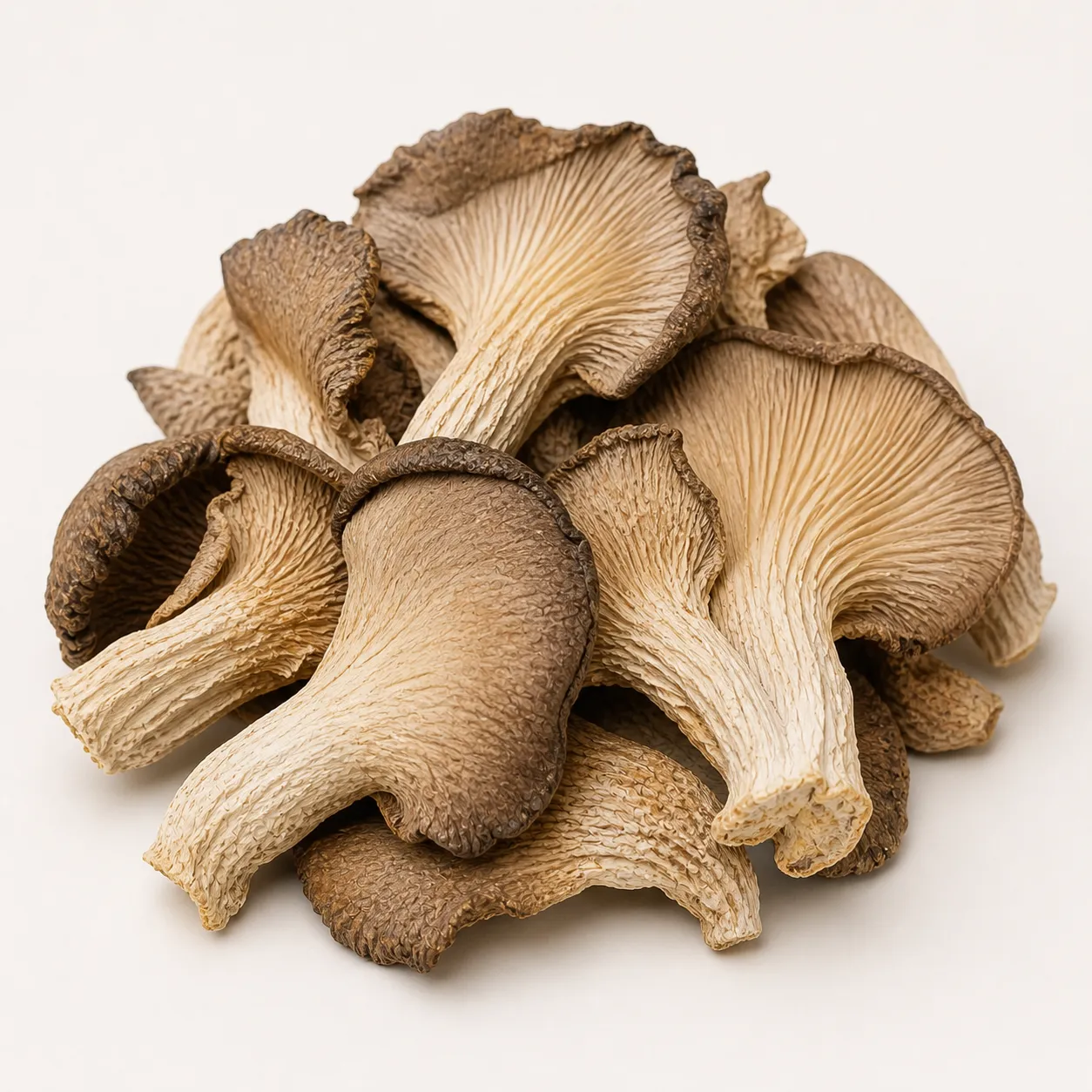
Wholesale
Dried Mushrooms
Oyster Mushroom
Dried oyster mushrooms suitable for bulk supply, restaurants, and distributors.
Wholesale price
$15.62/lb
$34.43/kg
Market reference
Approx. $35–60/kg
Need wholesale support?
Contact Fungi Origin for pricing, product inspection, pickup, GTA delivery, or courier shipping across Canada and the US for bulk dried mushroom orders.
Contact Us