Lion's Mane Mushroom
Lion's Mane Mushroom Health Benefits: What the Research Says
An honest look at Lion's Mane research — cognition, nerves, mood, gut. What the evidence supports, what's still preliminary, and how to use it.
By Editorial Team
Food sourcing and kitchen operations specialists covering ingredient procurement, storage science, and commercial kitchen efficiency across Canada.
Lion's Mane has accumulated more research than almost any other functional mushroom in the past two decades. The category has also accumulated more marketing hype than the research actually supports — bold claims about memory, anxiety, dementia, and "brain repair" appear constantly on social media and supplement labels. The honest picture is more nuanced: there's real, peer-reviewed science behind Lion's Mane, but the strongest evidence supports specific, narrow claims rather than the sweeping ones used in marketing. Lion's Mane mushroom is Hericium erinaceus, a medicinal mushroom whose researched health benefits include nerve growth factor stimulation, cognitive support in mild impairment, mood-related improvements, gastrointestinal protection, and immune modulation — with evidence ranging from preliminary to moderate depending on the specific claim.
Examine the Cognitive and Nerve-Growth Evidence
Lion's Mane's most-cited benefit is cognitive and neurological support, driven by compounds called hericenones (in the fruiting body) and erinacines (in the mycelium) that stimulate nerve growth factor (NGF) production. NGF is critical for the survival and function of neurons in the brain and peripheral nervous system.
What the research currently shows:
- Animal studies — consistent evidence of NGF stimulation and improved nerve regeneration
- In vitro studies — Lion's Mane extracts protect neural cells from various damage models
- Small human trial (Mori et al., 2009) — 30 elderly adults with mild cognitive impairment showed improved cognitive scores after 16 weeks of Lion's Mane supplementation
- Follow-up trials — additional small studies have replicated some findings, with mixed results
- Larger scale evidence — currently limited; large randomized controlled trials are still rare
A 2023 systematic review in the Journal of Functional Foods concluded that Lion's Mane shows "promising but preliminary" evidence for cognitive support. The honest interpretation: there's enough science to take it seriously as a wellness supplement, not enough to use it as a proven medical treatment.
Review the Mood and Anxiety Research
A second area of Lion's Mane research focuses on mood, anxiety, and depression. The mechanism likely overlaps with the nerve growth factor pathway — neurogenesis in the hippocampus is implicated in mood regulation.
Mood-related research highlights:
- Small clinical study (Nagano et al., 2010) — 30 women reported reduced anxiety and irritability after 4 weeks of Lion's Mane
- Animal models of depression — Lion's Mane shows antidepressant-like effects in standard behavior tests
- Hippocampal neurogenesis evidence — mechanism plausible based on rodent studies
- Inflammation-reduction pathway — possible secondary mechanism for mood benefits
- Limited replication — fewer follow-up studies than the cognitive research
Lion's Mane is reasonable to consider as part of a holistic mood-management approach, but it should never replace established treatments for depression or anxiety. The evidence is interesting and worth tracking; it's not yet definitive enough for medical claims. Anyone using Lion's Mane for mood-related goals should set realistic expectations and continue any prescribed treatments.
Look at Gastrointestinal and Ulcer Research
Traditional Asian medicine has used Lion's Mane for gastrointestinal complaints for centuries, and modern research has begun investigating these traditional uses with some interesting findings.
GI-related research highlights:
- H. pylori suppression — laboratory studies show Lion's Mane extracts inhibit Helicobacter pylori growth
- Gastric mucosa protection — animal studies show ulcer-protective effects
- Inflammatory bowel-related research — preliminary evidence of anti-inflammatory effects in IBD models
- Gut microbiome modulation — Lion's Mane beta-glucans may support beneficial gut bacteria
- Limited human evidence — most current evidence comes from animal and laboratory studies
The traditional use plus the emerging mechanism research makes the gastrointestinal angle one of the more interesting underdiscussed areas in Lion's Mane research. According to a 2024 review in Phytotherapy Research, the GI evidence is "convergent across traditional and laboratory contexts but lacks definitive human clinical trials."
Assess the Immune and Antioxidant Evidence
Like many medicinal mushrooms, Lion's Mane contains beta-glucans and other polysaccharides that interact with the immune system. The mechanism is well-established for the broader medicinal mushroom category, with Lion's Mane showing typical immunomodulatory effects.
Immune-related findings:
- Beta-glucan content — substantial; supports immune modulation similar to other medicinal mushrooms
- Macrophage activation — Lion's Mane polysaccharides activate immune cells in vitro
- Antioxidant capacity — well-documented in standard antioxidant assays
- NK cell activity — small studies suggest enhancement
- Inflammatory marker reduction — animal studies show reduced pro-inflammatory markers
For consumers and patients in immune-sensitive situations (cancer treatment, chronic illness, autoimmune conditions), Lion's Mane should always be discussed with a healthcare provider before use. Immune-modulation can be helpful in some contexts and counterproductive in others. A 2024 oncology-nutrition review specifically recommended professional supervision for Lion's Mane use in patients undergoing immunotherapy.
Use Lion's Mane Realistically and Safely
Lion's Mane has a strong safety profile in the existing research and centuries of traditional use. Reported side effects in clinical studies are rare and mild — occasional digestive upset and skin reactions in sensitive individuals.
Practical guidance for using Lion's Mane:
- Typical supplement dosing — 500–3,000 mg daily of dried mushroom or extract equivalent
- Culinary use — 25–50g of rehydrated Lion's Mane per serving in dishes
- Time to potential effects — most studies report 4–16 weeks before measurable cognitive changes
- Drug interactions — limited data; consult a provider if on blood thinners
- Pregnancy and lactation — insufficient data; avoid until more research exists
- Mushroom allergy — discontinue if any allergic-type reactions occur
For wellness-focused consumers, Lion's Mane is a reasonable functional-mushroom addition to a broader wellness routine. For culinary buyers and chefs, the health-benefit story adds value to menu positioning even when the dish isn't explicitly health-themed. Fungi Origin's Lion's Mane is sourced from cultivation operations with documented food-grade quality assurance.
Frequently Asked Questions
How long until lion's mane mushroom benefits kick in?
Most clinical studies of Lion's Mane report measurable cognitive or mood effects after 4–16 weeks of consistent daily use. Don't expect immediate results — Lion's Mane works through neurogenic and immune-modulatory pathways that operate on timescales of weeks rather than hours. Daily consistent use matters more than daily dose magnitude for most reported benefits.
Is fresh, dried, or extract the best lion's mane format?
Each format has strengths. Dried whole mushroom (rehydrated for cooking) provides a culinary use case alongside potential benefits at lower per-serving cost. Powder offers convenience for tea, smoothies, and supplements. Standardized extracts (typically beta-glucan or hericenone-standardized) deliver more consistent dosing for those tracking specific compound levels but cost more per serving.
Can I take lion's mane every day?
Daily Lion's Mane use is well-tolerated in published research, with consistent daily dosing typically producing the most measurable effects in clinical studies. There's no established maximum duration for safe daily use — many people use Lion's Mane continuously for months or years without reported issues. Discuss with your healthcare provider before combining with prescription medications, especially blood thinners or immunosuppressants.
Approach Lion's Mane with Realistic Expectations
Lion's Mane is one of the more research-supported functional mushrooms available, particularly for cognitive support, mood-related improvements, and gastrointestinal health. The evidence is encouraging but preliminary in most areas. Use it as part of a broader wellness strategy rather than as a standalone solution, and expect modest gradual effects rather than dramatic transformations.
Browse Fungi Origin's Lion's Mane selection — culinary-grade whole, sliced, and powder formats sourced from documented cultivation operations across Asia.
Shop this product
Buy lion’s mane mushroom wholesale
Stocked in Ontario. Free GTA delivery over $350 CAD; courier shipping across Canada and to the US.
Wholesale
Dried Mushrooms
Lion’s Mane Mushroom
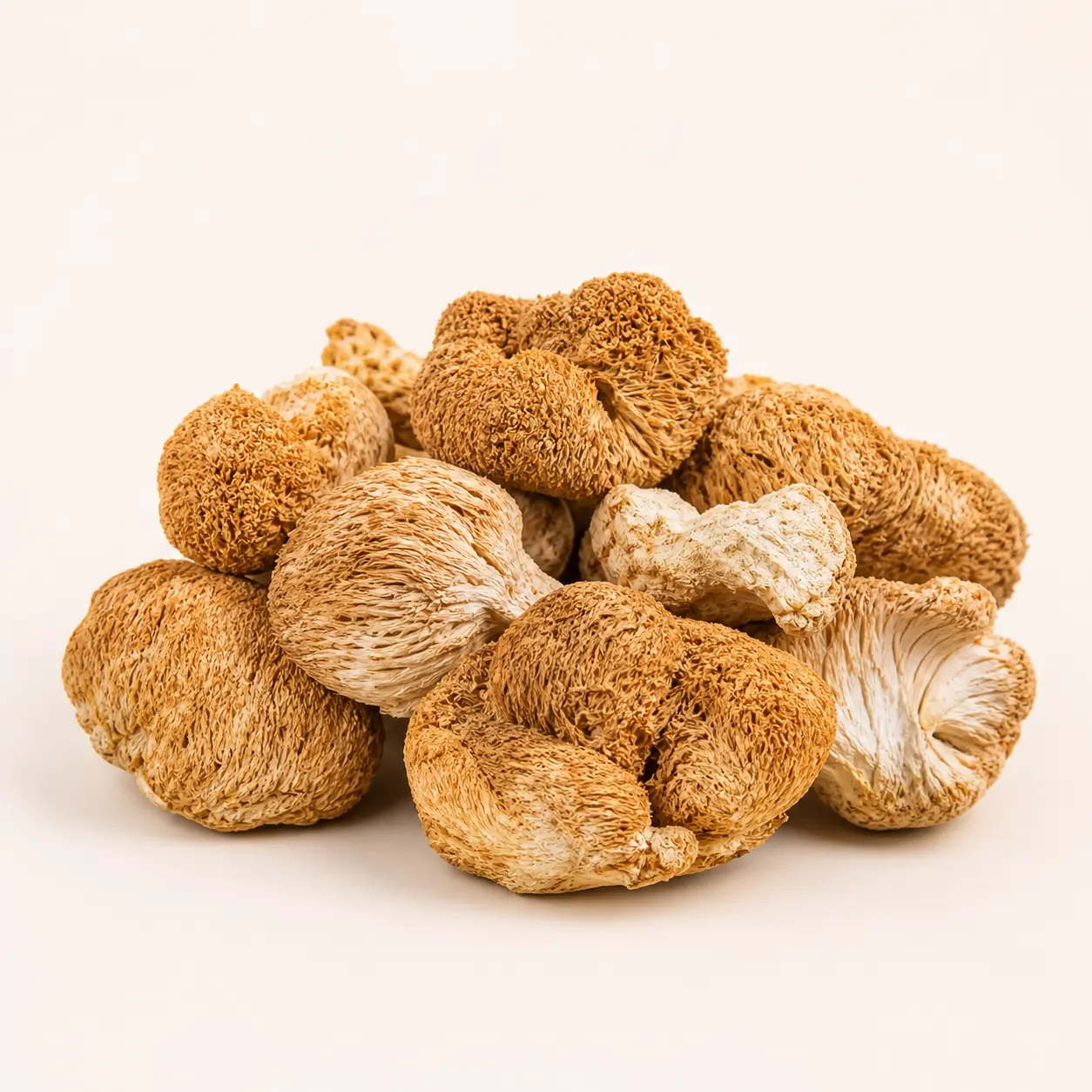
Top-grade dried lion's mane mushroom with reliable bulk supply.
Wholesale price
$19.43/lb
$42.84/kg
Market reference
Approx. $77/kg
Need wholesale support?
Contact Fungi Origin for pricing, product inspection, pickup, GTA delivery, or courier shipping across Canada and the US for bulk dried mushroom orders.
Contact Us