Lion's Mane Mushroom
Lion's Mane vs Shiitake Mushroom: Flavor, Health, and Best Uses
Lion's Mane vs Shiitake compared head-to-head — flavor, texture, health benefits, price, and which to choose for which dish or wellness goal.
By Editorial Team
Food sourcing and kitchen operations specialists covering ingredient procurement, storage science, and commercial kitchen efficiency across Canada.
Lion's Mane and shiitake are two of the most-recognized medicinal-and-culinary dual-purpose mushrooms on the Canadian market, and they're routinely treated as interchangeable when they're meaningfully different. The flavor profiles, textures, health-benefit research bases, and ideal applications diverge across almost every dimension. Choosing between them — or stocking both — should be deliberate. Lion's Mane (Hericium erinaceus) is a mild, sweet, fibrous-textured mushroom researched for cognitive and nerve support, while shiitake (Lentinula edodes) is a robust, savory, classic culinary mushroom researched for immune and cardiovascular health — they complement rather than substitute for each other.
Compare the Flavor Profiles Side by Side
The flavor difference between Lion's Mane and shiitake is dramatic. Shiitake delivers one of the strongest umami profiles in the entire mushroom kingdom, with rich, savory, almost meaty depth that dominates dishes. Lion's Mane delivers a subtle, sweet, mild profile that supports rather than dominates.
Side-by-side flavor descriptors:
- Shiitake — robust umami, savory, slightly smoky, rich, soy-adjacent
- Lion's Mane — mild, sweet, seafood-adjacent, low earthiness, delicate
In dishes, shiitake announces its presence — you taste shiitake. Lion's Mane integrates with surrounding ingredients, taking on the dish's seasoning profile. Both qualities have value depending on the dish goal. According to a 2023 sensory analysis, dried shiitake contains roughly 4x the free glutamate concentration of dried Lion's Mane — the chemical basis for the flavor-impact difference.
For cuisines that highlight mushroom flavor (Asian dashi, French sauce work, Italian pasta), shiitake wins. For cuisines that use mushroom as a textural protein substitute (vegan plates, Mediterranean preparations, plant-based mains), Lion's Mane wins.
Compare Texture and Cooking Behavior
Texture differences are equally pronounced. Shiitake offers a meaty, tender, slightly chewy texture similar to a high-quality cremini or portobello. Lion's Mane offers a fibrous, pulled-meat texture distinct from any other commercial mushroom.
Texture and cooking implications:
- Shiitake holds shape in stir-fries and pasta dishes
- Shiitake's flavor releases readily into surrounding liquids
- Lion's Mane shreds into long fibers unlike any other mushroom
- Lion's Mane requires high-heat technique for best texture
- Both rehydrate well but at different rates and to different end-states
- Both work in vegan applications, but for different reasons
A practical mental model: shiitake is a versatile mushroom that tastes profoundly like mushroom; Lion's Mane is a textural ingredient that happens to have mushroom origin. The cooking goal determines which makes sense.
Compare Health Benefit Profiles
Both mushrooms have substantial research bases, but the focus areas differ. Shiitake research emphasizes immune support, cardiovascular health, and antitumor activity. Lion's Mane research emphasizes cognitive support, nerve growth, and mood regulation.
Shiitake health-research areas:
- Beta-glucan immune support — well-established
- Cardiovascular benefits — eritadenine compound lowers cholesterol in studies
- Antitumor research — lentinan compound used as adjuvant cancer therapy in Japan
- Antiviral activity — laboratory evidence
- Vitamin D content — significant when sun-exposed
Lion's Mane health-research areas:
- Cognitive support — small clinical trials in mild cognitive impairment
- Nerve growth factor stimulation — animal studies
- Mood and anxiety — preliminary clinical evidence
- Gastrointestinal protection — traditional use plus emerging research
- Antioxidant activity — well-documented
Both have legitimate research backing. The difference is what they're researched for. According to a 2024 medicinal mushroom research review, shiitake has the longer publication history (decades of clinical work in Japan and China), while Lion's Mane has the more recent and rapidly growing research interest globally.
Compare Pricing and Availability
Shiitake is the most-affordable serious dried mushroom on the Canadian market — partly because it's commercially cultivated at very high volume globally. Lion's Mane is also cultivated but at smaller scale, and its newer commercial prominence means pricing reflects its premium positioning.
2025 Canadian wholesale pricing comparison:
- Dried shiitake (Grade A whole) — CAD $40–$80/kg
- Dried shiitake (sliced) — CAD $35–$65/kg
- Dried Lion's Mane (whole) — CAD $90–$140/kg
- Dried Lion's Mane (sliced) — CAD $80–$120/kg
Shiitake is roughly half the price of Lion's Mane at equivalent grades. For high-volume daily use, shiitake's pricing advantage compounds significantly. For specialty applications where Lion's Mane's specific texture is required, the premium is justified by the lack of substitutes.
Both are available year-round in Canadian wholesale through direct importers. Pricing on shiitake is more stable across seasons because of cultivation; Lion's Mane pricing has slightly more variation. A 2024 specialty foods purchasing analysis found that operators stocking both reported 12% more menu flexibility than single-mushroom-stock peers.
Match Each Mushroom to Its Best Applications
The most useful framework for choosing between Lion's Mane and shiitake is application matching. Each mushroom shines in specific contexts that the other can't fully cover.
Best shiitake applications:
- Asian-cuisine staples (dashi, ramen, stir-fries, sushi rice base)
- Pasta sauces and risottos requiring mushroom flavor presence
- Beef-and-mushroom dishes
- Rich savory soups and stocks
- Vegetarian dishes seeking mushroom-led flavor identity
- Pizza topping (after rehydration)
Best Lion's Mane applications:
- Vegan seafood preparations (crab cakes, scallops, lobster rolls)
- Plant-based pulled-style sandwiches and tacos
- Center-of-plate vegan main courses (roasted whole)
- Wellness-themed menu items
- Functional beverages and tea blends
- Tasting-menu vegan courses
Both can technically appear in many of the same dish categories, but the success of the dish depends on which mushroom is matched to the specific role. A "shiitake risotto" delivers strong mushroom flavor; a "Lion's Mane risotto" delivers subtle savory depth with textural interest. Both are valid; they're different dishes.
Frequently Asked Questions
Should I substitute Lion's Mane for shiitake in a recipe?
Lion's Mane substitutes for shiitake only when the recipe role is "textural mushroom presence." For "flavor-defining mushroom" roles (Asian dashi, mushroom-forward pastas), the substitution disappoints because Lion's Mane lacks shiitake's flavor intensity. The reverse substitution — shiitake for Lion's Mane — works less often because shiitake's strong flavor disrupts plant-based seafood preparations where Lion's Mane shines.
Which is better for brain health, Lion's Mane or shiitake?
Current research on cognitive and brain health favors Lion's Mane over shiitake. Lion's Mane has specific compounds (hericenones and erinacines) that stimulate nerve growth factor production, with small clinical evidence in mild cognitive impairment. Shiitake's research focuses on immune and cardiovascular health rather than cognition. For brain-health goals, Lion's Mane is the better-researched choice.
Can I stock both Lion's Mane and shiitake in one operation?
Yes, and most serious culinary operations do. Shiitake handles daily cooking applications across cuisines; Lion's Mane handles specialty plant-based and wellness-themed items. Combined inventory at a Canadian restaurant typically runs 1–2kg shiitake and 0.5–1kg Lion's Mane monthly, with combined wholesale cost of roughly CAD $150–$280 per month — modest against the application range it supports.
Choose Each Mushroom for What It Does Best
Lion's Mane and shiitake aren't competitors — they're complementary tools serving different culinary and wellness goals. Shiitake delivers classic mushroom flavor across cuisines and immune-cardiovascular health research. Lion's Mane delivers fibrous meat-substitute texture, subtle flavor, and cognitive-support research. Choose by application; stock both for the fullest range.
Browse Fungi Origin's Lion's Mane selection — whole, sliced, and powder formats with full origin documentation.
Shop this product
Buy lion’s mane mushroom wholesale
Stocked in Ontario. Free GTA delivery over $350 CAD; courier shipping across Canada and to the US.
Wholesale
Dried Mushrooms
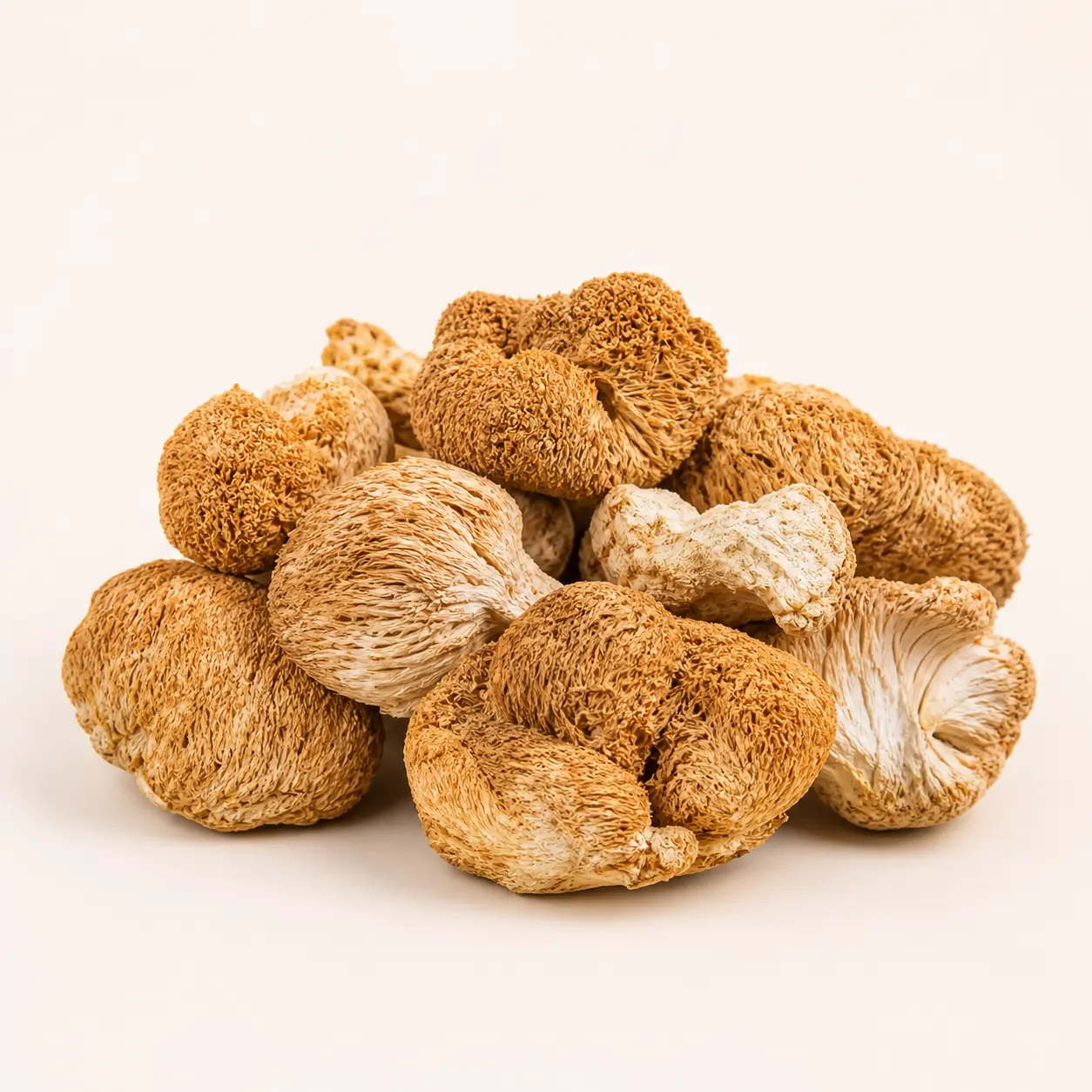
Lion’s Mane Mushroom
Top-grade dried lion's mane mushroom with reliable bulk supply.
Wholesale price
$19.43/lb
$42.84/kg
Market reference
Approx. $77/kg
Need wholesale support?
Contact Fungi Origin for pricing, product inspection, pickup, GTA delivery, or courier shipping across Canada and the US for bulk dried mushroom orders.
Contact Us