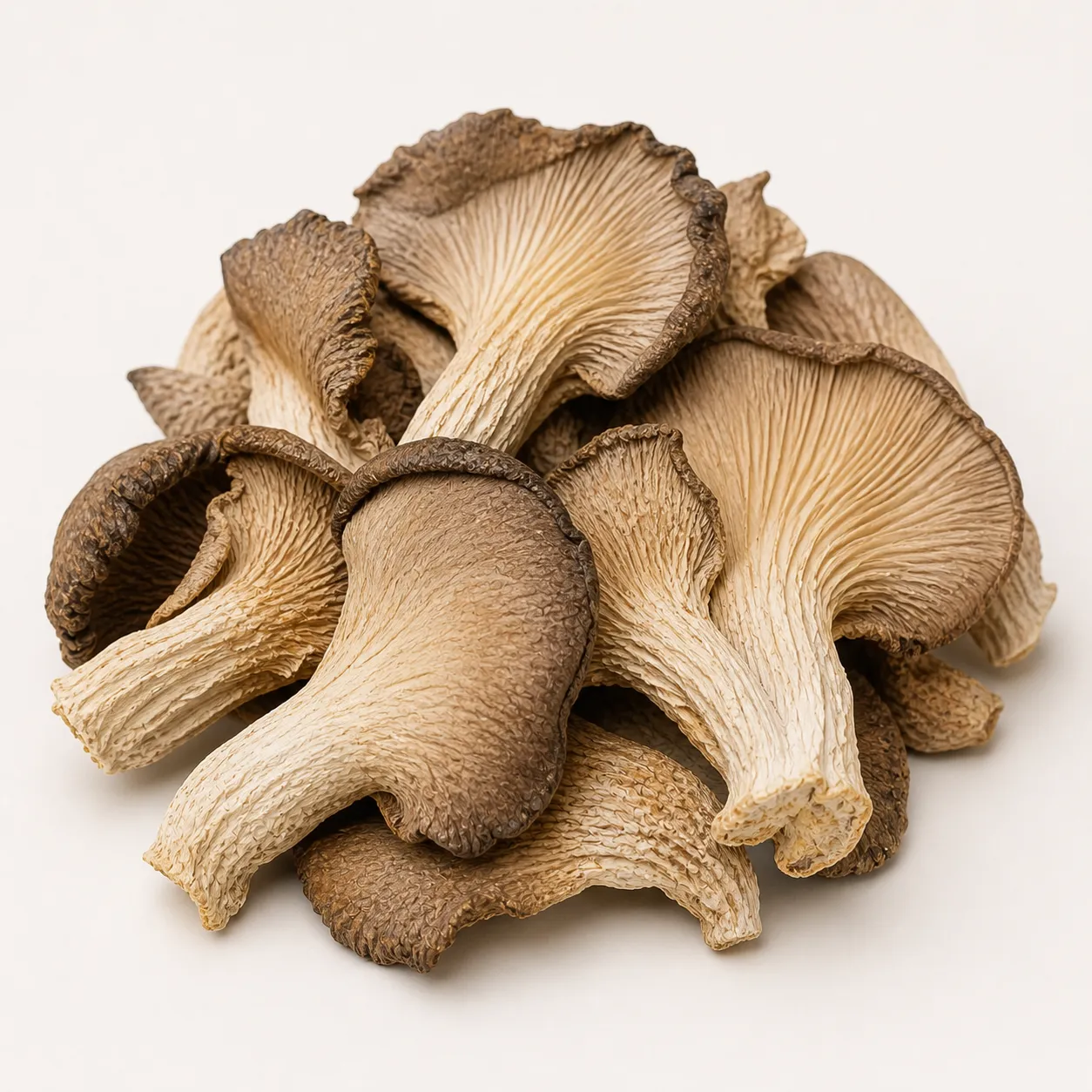
Oyster Mushroom
Oyster vs Shiitake Mushroom: Flavor, Use, and Best Choice
Oyster vs shiitake mushroom — flavor, texture, price, and best uses compared head-to-head. Which to stock and when to use each.
By Editorial Team
Food sourcing and kitchen operations specialists covering ingredient procurement, storage science, and commercial kitchen efficiency across Canada.
Oyster and shiitake are two of the most-recognized cultivated dried mushrooms in the Canadian market — and routinely treated as interchangeable when they actually fill different culinary roles. The flavor profiles, textures, ideal applications, and pricing structures diverge meaningfully. Understanding when to use each — or when to stock both — separates informed sourcing from default-mode purchasing. Oyster mushrooms (Pleurotus species) are mild, adaptable, structurally varied mushrooms suited to plant-based meat substitutes and integrated dishes, while shiitake (Lentinula edodes) are robust, umami-driven flavor-defining mushrooms central to Asian cuisine — they complement rather than substitute for each other across most applications.
Compare the Flavor Profiles Side by Side
The flavor difference between oyster mushrooms and shiitake is dramatic. Shiitake delivers one of the strongest umami profiles in the entire mushroom kingdom — robust, savory, almost meaty depth that dominates dishes. Oyster mushrooms deliver a mild, adaptable profile that supports rather than dominates.
Side-by-side flavor descriptors:
- Shiitake — robust umami, savory, slightly smoky, rich, soy-adjacent
- Pearl oyster — mild, slightly anise/seafood, delicate
- King oyster — nutty, savory, more complex than pearl but milder than shiitake
In dishes, shiitake announces its presence — you taste shiitake clearly. Oyster mushrooms integrate with surrounding ingredients, taking on the dish's seasoning profile. Both qualities have value depending on the dish goal.
According to a 2023 sensory analysis published in Food Chemistry, dried shiitake contains roughly 4x the free glutamate concentration of pearl oyster mushroom — the chemical basis for the flavor-impact difference.
For cuisines that highlight mushroom flavor (Asian dashi, Italian risotto, French sauce work), shiitake usually wins. For cuisines that use mushroom as a textural protein substitute or integrated ingredient, oyster mushrooms work better.
Compare Texture and Cooking Behavior
Texture differences are equally pronounced. Shiitake offers a meaty, tender, slightly chewy texture similar to a high-quality cremini. Oyster mushrooms span a wider texture range — pearl oyster is delicate and tender; king oyster is dense and meaty.
Texture and cooking implications:
- Shiitake holds shape in stir-fries, soups, and braises across most cooking methods
- Shiitake's flavor releases readily into surrounding liquids
- Pearl oyster integrates rather than holds shape in long cooks
- King oyster holds shape under high-heat searing for plant-based meat applications
- Both hold up in shorter-cooked sautés and stir-fries
A practical mental model: shiitake is a versatile mushroom with strong flavor identity; oyster mushrooms are a versatile mushroom family with strong textural variety. The cooking goal determines which makes sense.
Compare Pricing and Availability
Both are commercially cultivated at very large scale globally, which keeps both supplies stable and pricing competitive. But oyster mushrooms generally price slightly higher than basic-grade shiitake.
2025 Canadian wholesale pricing comparison:
- Sliced koshin shiitake (Grade A) — CAD $35–$65/kg
- Whole koshin shiitake (Grade A) — CAD $40–$80/kg
- Dried pearl oyster (Grade A whole) — CAD $50–$95/kg
- Dried king oyster (Grade A whole) — CAD $80–$140/kg
- Dried donko shiitake (premium) — CAD $120–$170/kg
For high-volume daily use, basic-grade sliced shiitake offers the most affordable serious dried mushroom on the Canadian wholesale market. Pearl oyster is competitive but slightly higher; king oyster commands a premium driven by its plant-based protein applications.
Both are available year-round in Canadian wholesale through direct importers. Pricing on shiitake is more stable across seasons because of cultivation maturity; oyster mushroom pricing is also stable but with slightly more variation.
Match Each Mushroom to Its Best Applications
The most useful framework for choosing between oyster mushrooms and shiitake is application matching. Each mushroom shines in specific contexts that the other can't fully cover.
Best shiitake applications:
- Asian-cuisine staples (dashi, ramen, stir-fries, sushi rice base)
- Pasta sauces and risottos requiring mushroom flavor presence
- Beef-and-mushroom dishes
- Rich savory soups and stocks
- Vegetarian dishes seeking mushroom-led flavor identity
- Pizza topping (after rehydration)
Best oyster mushroom applications:
- Vegan bacon and crispy snack applications
- Plant-based pulled-style fillings (sandwiches, tacos)
- Vegan scallops and steak preparations (king oyster)
- Lighter pasta and grain bowl integrations
- Vegetable-forward dishes where mushroom plays a supporting role
- Texture-led plant-based menu items
Both can technically appear in many of the same dish categories, but the success depends on which mushroom is matched to the specific role. A "shiitake risotto" delivers strong mushroom flavor; an "oyster mushroom risotto" delivers gentler savory depth with textural variety. Both are valid; they're different dishes.
Stock Both for Maximum Versatility
Most serious culinary operations stock both shiitake and oyster mushrooms simultaneously. The combined inventory expands menu range significantly versus single-mushroom-stock peers.
Sample dual-stock approach for a Canadian restaurant:
- Sliced koshin shiitake — 5–8kg monthly for daily Asian-cuisine and pasta applications
- Pearl oyster (sliced) — 3–5kg monthly for vegan applications and lighter dishes
- King oyster (whole) — 1–3kg monthly for scallop and meat-substitute preparations
- Whole koshin shiitake — 1–2kg monthly for whole-cap presentations
- Donko shiitake — 0.5–1kg monthly for premium dishes
Combined monthly wholesale spending typically runs CAD $400–$1,000, supporting menu revenue 25–40x that amount. According to 2024 Canadian foodservice purchasing data, restaurants stocking both shiitake and oyster mushroom reported 26% more menu flexibility than single-mushroom-stock peers.
Frequently Asked Questions
Should I substitute oyster mushroom for shiitake in a recipe?
Substitute oyster mushroom for shiitake only when the recipe role is "textural mushroom presence" rather than "flavor-defining mushroom." For Asian dashi, ramen tare, and umami-driven dishes, the substitution disappoints because oyster mushrooms lack shiitake's flavor intensity. The reverse substitution (shiitake for oyster mushroom) often imposes too much flavor on plant-based dishes designed around oyster mushroom's neutrality.
Which is better for vegan dishes, oyster or shiitake?
Both work in vegan applications, but for different roles. Oyster mushroom dominates plant-based meat substitute applications (vegan bacon, pulled fillings, vegan scallops). Shiitake dominates umami-driven vegan applications (vegan ramen, mushroom-forward stocks, plant-based meat replacement in beef-style preparations). Most plant-based restaurants stock both for full menu range.
Which is more nutritious, oyster mushroom or shiitake?
Both deliver meaningful nutrition with different strengths. Shiitake offers higher beta-glucan and lentinan content with documented research on cardiovascular and immune support. Oyster mushrooms offer more protein per gram and similar fiber content. For most dietary purposes, the differences are modest. The choice should follow culinary application rather than nutrition alone.
Choose Based on the Role Each Plays
Oyster mushrooms and shiitake aren't competitors — they're complementary tools serving different culinary goals. Shiitake delivers signature umami across Asian and continental cuisines; oyster mushrooms deliver versatile plant-based protein applications and integrated dish support. Choose by application; stock both for the fullest range.
Browse Fungi Origin's full mushroom range including both shiitake and oyster mushroom in whole, sliced, and powder formats with full origin documentation.
Shop this product
Buy oyster mushroom wholesale
Stocked in Ontario. Free GTA delivery over $350 CAD; courier shipping across Canada and to the US.
Wholesale
Dried Mushrooms
Oyster Mushroom
Dried oyster mushrooms suitable for bulk supply, restaurants, and distributors.
Wholesale price
$15.62/lb
$34.43/kg
Market reference
Approx. $35–60/kg
Need wholesale support?
Contact Fungi Origin for pricing, product inspection, pickup, GTA delivery, or courier shipping across Canada and the US for bulk dried mushroom orders.
Contact Us