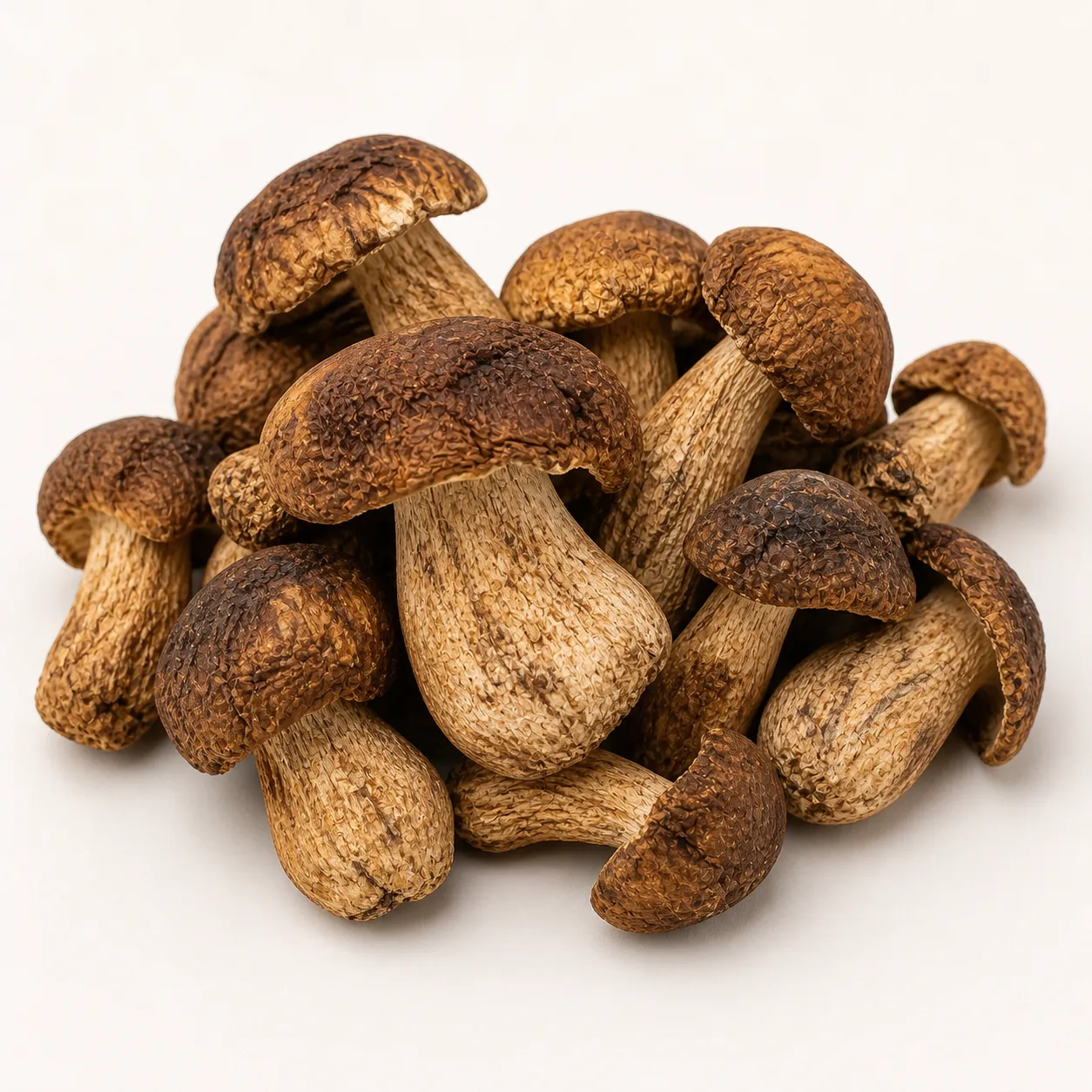
Shiitake Mushroom
Shiitake Mushroom Health Benefits and Nutrition Facts
Shiitake delivers immune-supporting beta-glucans, cholesterol-lowering eritadenine, and serious vitamin D when sun-exposed. Honest research overview for Canadian buyers.
By Editorial Team
Food sourcing and kitchen operations specialists covering ingredient procurement, storage science, and commercial kitchen efficiency across Canada.
Shiitake has more research behind its health claims than any other commercially-available dried mushroom. Decades of clinical and laboratory research, particularly from Japan, China, and South Korea, have established a credible evidence base for several specific health benefits — alongside the marketing-driven claims that aren't well-supported. The honest picture: shiitake offers real, measurable nutrition and several specific researched effects, with a longer track record than newer "trend" functional mushrooms. Shiitake mushrooms are nutrient-dense edible fungi rich in beta-glucans, the immune-modulating compound lentinan, the cholesterol-lowering compound eritadenine, B vitamins, copper, selenium, and (when sun-exposed) significant vitamin D, with researched benefits in immune support, cardiovascular health, and possibly cancer-adjuvant therapy.
Examine the Macronutrient and Mineral Profile
Shiitake delivers a remarkably nutrient-dense profile for a low-calorie food. A standard 30g portion of dried shiitake (which rehydrates to roughly 180g) provides approximately 90 calories, 3g of protein, 22g of carbohydrate (12g of which is fiber), and minimal fat.
Mineral and vitamin profile per 30g dried shiitake:
- Copper — 0.8mg (89% of daily value)
- Selenium — 14μg (25% DV)
- Manganese — 0.6mg (28% DV)
- B5 (pantothenic acid) — significant levels
- B3 (niacin) — significant levels
- Riboflavin — meaningful contribution
- Vitamin D — variable; high if sun-cured
The fiber content is particularly noteworthy — 12g of fiber per 30g dried portion is exceptional. The bulk of this fiber consists of beta-glucans, the compounds central to shiitake's immune-research story. According to a 2023 nutritional analysis published in Journal of Food Composition and Analysis, dried shiitake provides among the highest beta-glucan concentrations of any commonly-consumed food.
Understand Beta-Glucans and Immune Support
Shiitake contains two well-studied beta-glucan compounds — lentinan and KS-2 — that have been researched for immune-modulating effects for over four decades. Lentinan in particular is one of the most-studied medicinal mushroom compounds in the world.
Beta-glucan and immune research highlights:
- Lentinan — used as approved adjuvant cancer therapy in Japan since 1985
- KS-2 polysaccharide — researched for antiviral and immune-modulating activity
- Macrophage activation — laboratory studies show enhanced immune cell activity
- Beta-glucan general benefits — supported by extensive food-science research
- Immunomodulation rather than stimulation — beta-glucans appear to balance rather than overactivate immunity
Lentinan is unusual in the medicinal mushroom landscape because it has actually been used clinically — as an adjuvant therapy alongside chemotherapy in stomach and colorectal cancer treatment in Japan. The treatment delivers lentinan intravenously rather than through dietary mushroom consumption, but the foundational research base is significantly stronger than for most "wellness mushrooms."
For everyday Canadian consumers, dietary shiitake provides modest beta-glucan exposure that may support general immune health. Anyone with active immune-system conditions or undergoing cancer treatment should consult a healthcare provider before substantial supplementation.
Review Cardiovascular and Cholesterol Research
Beyond immune support, shiitake has accumulated meaningful research around cardiovascular health, primarily through the compound eritadenine, which appears to reduce serum cholesterol levels in animal and human studies.
Cardiovascular research highlights:
- Eritadenine — unique to shiitake; reduces total cholesterol in clinical trials
- Beta-glucan fiber — supports general cholesterol management
- Animal studies — consistent cholesterol-lowering effects across multiple trials
- Human studies — small but suggestive effects on LDL cholesterol
- Blood pressure research — preliminary evidence; more research needed
A 2022 systematic review in Nutrients examined 14 studies on shiitake and cardiovascular markers and concluded that the evidence supports "modest beneficial effects on cholesterol profiles" — though the review noted that effect sizes are smaller than those produced by pharmaceutical interventions. Shiitake is reasonable as part of a heart-healthy diet, not as a replacement for medical management of cardiovascular disease.
Look at Vitamin D and the Sun-Exposure Effect
One of shiitake's most underappreciated health properties is its capacity to produce significant vitamin D when exposed to UV light. Most mushrooms produce ergosterol that converts to vitamin D2 under UV exposure. Shiitake is particularly responsive to this conversion.
Vitamin D facts for shiitake:
- UV-exposed dried shiitake — can deliver 400+ IU vitamin D per 30g
- Standard non-UV-exposed shiitake — modest vitamin D content
- Sun-curing process — traditional drying in sunlight produces high vitamin D
- Vitamin D2 vs D3 — D2 is the form produced; clinically useful if less efficient than D3
- Important for plant-based diets — shiitake is one of few non-animal vitamin D sources
For Canadian consumers — particularly anyone in northern latitudes during winter months — UV-exposed shiitake offers a meaningful dietary vitamin D contribution. Some specialty suppliers explicitly market UV-exposed or "sun-cured" shiitake at slight pricing premium for the vitamin D content. Ask suppliers about UV-exposure status if vitamin D is a priority.
Use Shiitake Realistically and Safely
Shiitake has a generally strong safety profile but with one specific caveat: improperly cooked shiitake can cause "shiitake dermatitis," a temporary skin rash from the compound lentinan that resolves with proper cooking.
Practical guidance:
- Always cook shiitake thoroughly — at least 5 minutes once it hits heat
- Rehydrate dried shiitake before any preparation
- Standard culinary portion — 30g dried (rehydrated) per serving
- Daily safe consumption — no defined upper limit for culinary use
- Drug interactions — consult provider if on immunosuppressants or anticoagulants
- Allergies — discontinue if any allergic reactions occur (rare)
For wellness consumers, regular shiitake consumption as part of meals delivers modest functional benefits with very low risk. For supplement-grade applications (lentinan extracts, beta-glucan concentrates), work with a licensed practitioner and consider the substantial dose-response gap between dietary mushroom consumption and pharmaceutical-grade extracts. Fungi Origin's dried shiitake is sourced from documented cultivation operations with food-safety testing on every wholesale shipment.
Frequently Asked Questions
Are dried shiitake mushrooms healthier than fresh?
Dried shiitake delivers higher per-gram concentrations of most nutrients than fresh, simply because water is removed without affecting non-volatile compounds. Beta-glucans, eritadenine, and minerals concentrate proportionally. Vitamins B and C decline modestly with drying. For practical purposes, a 30g portion of rehydrated dried shiitake delivers roughly equivalent total nutrition to 180g of fresh — the rehydrated equivalent.
Can shiitake mushrooms boost immunity?
Shiitake contains beta-glucans (lentinan, KS-2) shown in laboratory and clinical research to modulate immune system activity. The dietary effect is modest compared to pharmaceutical extracts, but regular shiitake consumption may support general immune health as part of a broader nutrient-rich diet. People with autoimmune conditions or on immunosuppressant medications should consult a healthcare provider before substantial supplementation.
Is shiitake safe to eat every day?
Yes, shiitake is safe for daily culinary consumption for most people. Standard portions (around 30g dried, rehydrated) integrated into varied meals deliver beta-glucans and other nutrients without overdose concerns. Always cook shiitake thoroughly to avoid the rare but possible "shiitake dermatitis" reaction from underdone preparation. Discuss with healthcare provider before substantial supplement-grade consumption.
Add Shiitake to a Nutrition-Forward Kitchen
Shiitake delivers real, measurable, well-researched nutritional value alongside its central role in Asian cuisine — beta-glucans for immune support, eritadenine for cholesterol management, B vitamins, minerals, and (when sun-exposed) significant vitamin D. For Canadian chefs and retailers building nutrition-forward menus or specialty product lines, dried shiitake earns shelf space on both flavor and nutrition grounds.
Browse Fungi Origin's dried shiitake collection — including UV-exposed grades for higher vitamin D content — for documented quality and full nutrition transparency.
Need wholesale support?
Contact Fungi Origin for pricing, product inspection, pickup, GTA delivery, or courier shipping across Canada and the US for bulk dried mushroom orders.
Contact Us