Lion's Mane Mushroom
What Is Lion's Mane Mushroom? Benefits, Uses, and Buying Guide
Lion's Mane (Hericium erinaceus) is a meaty, brain-supporting medicinal mushroom. Learn taste, texture, health benefits, and buying for Canadian buyers.
By Editorial Team
Food sourcing and kitchen operations specialists covering ingredient procurement, storage science, and commercial kitchen efficiency across Canada.
Lion's Mane has gone from obscure foraging curiosity to one of the fastest-growing functional mushrooms in North American retail and foodservice. Canadian search interest in "lion's mane" has more than tripled since 2021, driven by both wellness positioning (cognitive health, nerve support) and culinary positioning (vegan seafood substitute). Most buyers searching the term don't yet know what they're actually getting. Lion's Mane mushroom is the common name for Hericium erinaceus, a white, shaggy-looking medicinal and culinary mushroom prized for its meaty crab-like texture, mild seafood-adjacent flavor, and a body of research suggesting cognitive and neurological support benefits.
Recognize the Distinctive Appearance and Botany
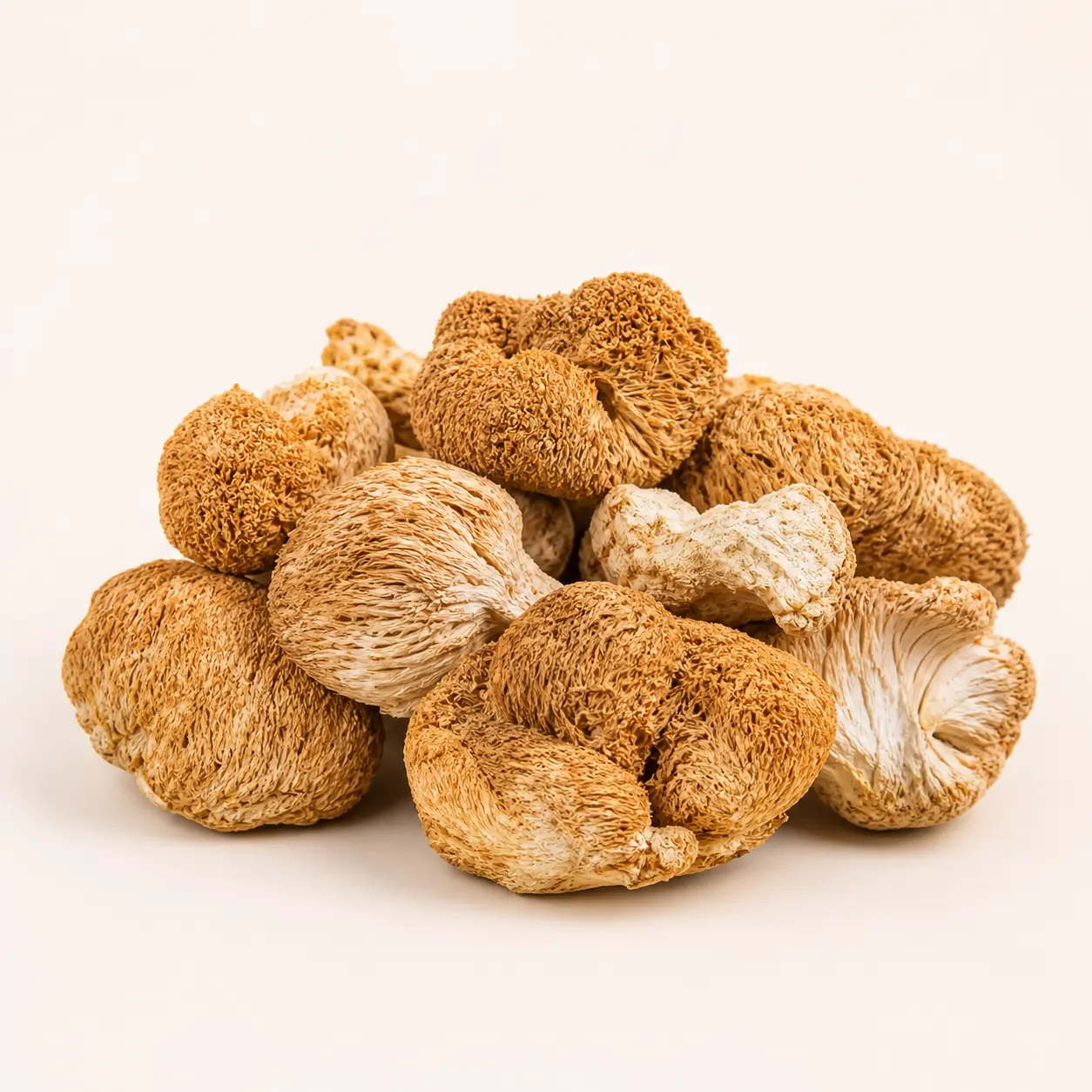
Lion's Mane looks unlike any other commercial mushroom. Instead of caps and stems, the fruiting body forms a single white globular mass with long, soft, hanging spines — sometimes described as resembling a lion's mane, a pom-pom, or sea coral. The spines themselves are the edible spore-producing surface; in most other mushrooms, gills or pores serve this role.
Key visual and botanical facts:
- Single rounded fruiting body rather than capped mushrooms
- White color with potential cream tinges as it ages
- Hanging spines 1–5cm long covering the surface
- Grows on dead or dying hardwoods — oak, beech, maple, birch
- Cultivated commercially as well as foraged
- Family Hericiaceae — distinct from common Agaricaceae mushrooms
Unlike porcini and morels, Lion's Mane is successfully cultivated at commercial scale, primarily in China, Japan, the U.S., and increasingly Canada. Most dried Lion's Mane in Canadian retail comes from cultivation rather than wild foraging.
Understand the Texture That Made It Famous
Lion's Mane's commercial breakthrough in North American foodservice was driven by its texture, not its flavor. When properly prepared, the fruiting body has a remarkable resemblance to seafood — specifically lobster, crab, or scallop — both visually (white, fibrous flesh) and texturally (firm, pulled, chewy).
Texture characteristics:
- Fibrous, pulled-meat structure when cooked
- Firm bite with a slight chewy resistance
- Holds shape under high-heat cooking — sears beautifully
- Releases water during cooking — must be properly handled
- Springy when properly cooked, rubbery when underdone
- Visual resemblance to crab or lobster meat in finished dishes
The texture has driven Lion's Mane's prominence on plant-based menus across Canada. Vegan crab cakes, vegan scallops, vegan lobster rolls, and vegan "pulled" sandwiches all rely on Lion's Mane's natural meat-substitute potential. The mushroom doesn't pretend to be seafood — it just happens to behave like seafood when cooked.
Examine the Flavor Profile
Lion's Mane's flavor is mild relative to porcini, morel, or shiitake — not the most intensely flavored mushroom in the dry pantry, but distinctive in its own way. The dominant notes are subtly sweet, mildly seafood-adjacent, almost shellfish-like, with very low earthiness compared to most mushrooms.
Flavor descriptors:
- Mildly sweet with lobster or crab undertones
- Low earthiness — a notable contrast to porcini/morel/shiitake
- Clean and delicate — easily overwhelmed by aggressive seasoning
- Develops nutty notes when properly browned
- Pairs naturally with butter, lemon, garlic, herbs
- Complements seafood-style preparations
The mild flavor is actually a strength. Lion's Mane can take on the seasoning profile of a dish without imposing its own identity, which makes it remarkably versatile across cuisines. A lemon-butter Lion's Mane preparation reads like seafood; a teriyaki Lion's Mane preparation reads like Asian seafood; a brown-butter sage Lion's Mane preparation reads Italian. Few other mushrooms have this chameleon quality.
Learn the Established Health Benefits
Lion's Mane's prominence in the wellness space rests on one of the more substantial research bases for any specialty mushroom. The mushroom contains compounds — hericenones (in the fruiting body) and erinacines (in the mycelium) — that have been shown in laboratory and small clinical studies to support nerve growth factor (NGF) production in neural tissue.
Documented and researched health-related areas:
- Cognitive function — small clinical trials suggest improvements in mild cognitive impairment
- Nerve regeneration — animal studies show enhanced nerve repair markers
- Mood — limited but suggestive evidence around anxiety and depression
- Gastrointestinal health — traditional use for ulcers, supported by some animal research
- Immune modulation — beta-glucan-driven immune support
- Antioxidant activity — well-documented in vitro
Important honesty: most of the strongest evidence comes from animal models or small human studies. Lion's Mane is a promising functional mushroom, not a proven medical treatment. A 2023 systematic review in the Journal of Functional Foods concluded that the human evidence is "encouraging but preliminary." For wellness-driven consumers, that's enough; for medical claims, it isn't.
Choose the Right Lion's Mane Format
Dried Lion's Mane comes to Canadian buyers in three primary formats, each suited to different uses. Most retail and foodservice buyers don't realize the format choice meaningfully affects what they can do with the product.
The three formats:
- Whole dried fruiting bodies — for culinary use, rehydration, and meaty texture applications
- Dried slices or chunks — pre-cut for fast prep, restaurant-friendly format
- Powder — for tea, smoothies, supplements, and wellness applications
Whole and sliced formats are interchangeable for most cooking applications; the difference is prep-time convenience. Powder serves an entirely different market — wellness consumers, supplement makers, tea blends, functional beverages. Most Canadian wholesale orders span at least two formats. Fungi Origin stocks all three formats with format-specific grading.
Frequently Asked Questions
Does lion's mane mushroom actually improve memory?
Research on Lion's Mane and memory is encouraging but preliminary. Several small clinical trials in mild cognitive impairment have shown modest improvements on standard cognitive tests, but the studies are limited in size and duration. Animal research provides stronger mechanism evidence around nerve growth factor production. Lion's Mane is reasonable to use as part of a wellness routine, but it's not a proven medical treatment for memory loss.
Can you cook lion's mane like meat?
Yes, Lion's Mane is one of the most meat-like mushrooms in the dry pantry. Its fibrous fruiting body pulls into shreds resembling crab or lobster meat, sears beautifully into "scallop" style medallions, and holds shape during long cooks like braised meat. Vegan menus across Canada use Lion's Mane to create plant-based crab cakes, scallops, lobster rolls, and pulled-style sandwiches.
Where does lion's mane mushroom come from?
Lion's Mane (Hericium erinaceus) grows naturally on dead or dying hardwood trees across North America, Europe, and Asia. It's also cultivated commercially at significant scale, primarily in China, Japan, the U.S., and parts of Canada. Most dried Lion's Mane in Canadian retail comes from cultivation rather than foraging, which keeps pricing more stable than purely wild-foraged mushrooms.
Stock Lion's Mane for Canadian Wellness and Culinary Markets
Lion's Mane bridges two markets — wellness consumers seeking functional mushrooms and culinary buyers seeking plant-based seafood alternatives. Few other dried mushrooms cross both segments as effectively. Whether you're a chef building plant-based menu items, a retailer stocking the wellness shelf, or a wellness-brand formulator, dried Lion's Mane in the right format and grade is increasingly central to the Canadian specialty mushroom landscape.
Browse Fungi Origin's Lion's Mane selection — whole, sliced, and powder formats with full origin and quality documentation.
Shop this product
Buy lion’s mane mushroom wholesale
Stocked in Ontario. Free GTA delivery over $350 CAD; courier shipping across Canada and to the US.
Wholesale
Dried Mushrooms
Lion’s Mane Mushroom
Top-grade dried lion's mane mushroom with reliable bulk supply.
Wholesale price
$19.43/lb
$42.84/kg
Market reference
Approx. $77/kg
Need wholesale support?
Contact Fungi Origin for pricing, product inspection, pickup, GTA delivery, or courier shipping across Canada and the US for bulk dried mushroom orders.
Contact Us