Chanterelle Mushroom
Wild-Foraged vs Cultivated Chanterelles: The Truth
Are chanterelles cultivated? The honest answer about wild-only sourcing, why it matters, and how it shapes pricing, sustainability, and menu storytelling.
By Editorial Team
Food sourcing and kitchen operations specialists covering ingredient procurement, storage science, and commercial kitchen efficiency across Canada.
Many Canadian buyers assume chanterelles are cultivated like shiitake or oyster mushrooms — they aren't, and won't be at any meaningful commercial scale in the foreseeable future. The wild-only reality shapes pricing, supply, sustainability questions, and menu storytelling in ways that affect every chanterelle purchasing decision. Knowing the truth distinguishes informed sourcing from confused assumptions. Chanterelle mushrooms are virtually 100% wild-foraged at commercial scale because they form mycorrhizal partnerships with specific tree species (oak, beech, birch, pine) that require complex forest ecosystems impossible to replicate in cultivation, making "cultivated chanterelle" a category that doesn't meaningfully exist in the global commercial market.
Understand Why Chanterelles Resist Cultivation
The reason chanterelles can't be commercially cultivated comes down to mycorrhizal symbiosis — a complex partnership between fungus and tree roots that exchanges nutrients across living root systems. Chanterelles need this partnership to fruit. Without it, the fungus can grow as mycelium but won't produce fruiting bodies (the mushroom caps that get harvested).
The cultivation challenges:
- Mycorrhizal partnerships required with mature host trees
- Soil microbiome dependencies — specific bacterial and fungal communities
- Climate and weather sensitivity — temperature, rainfall, seasonality matter
- Slow timeline — chanterelles can take 5–10+ years to first fruit on a host tree
- Yield unpredictability — even in established forests, yields vary 50%+ year-over-year
- Economic infeasibility — cultivation cost per kilogram exceeds market pricing
Research-scale chanterelle cultivation has succeeded in laboratory and forest-plot trials. Commercial cultivation at the scale that would feed retail and foodservice supply does not exist. According to a 2024 specialty mushroom industry review, no commercial chanterelle cultivation operation produces meaningful volume globally — every chanterelle sold at scale is wild-harvested.
Recognize Major Wild-Foraging Regions
Wild chanterelles are foraged across temperate-zone forests worldwide. The major commercial sourcing regions each have distinct seasonal windows, flavor characteristics, and supply patterns.
The major commercial chanterelle sourcing regions:
- Pacific Northwest (Oregon, Washington, BC) — late summer to mid-fall; deep golden color; premium pricing
- Yunnan and Sichuan, China — summer to early fall; large volume; consistent quality
- Lithuania and the Baltic states — late summer; orange-yellow tones; growing share
- Romania and Eastern Europe — late summer to fall; small-to-medium chanterelles; competitive pricing
- France (Périgord, Aquitaine) — late summer; small-volume premium positioning
Each region produces chanterelles with subtly different profiles based on host trees, climate, and forest microbiome. Pacific Northwest chanterelles often have the deepest color and most robust caps; Yunnan chanterelles dominate global volume; Eastern European chanterelles offer competitive pricing on smaller-cap formats. Most chefs and buyers don't choose by region — they choose by quality grade — but origin matters for menu storytelling at fine dining.
Examine the Sustainability Conversation
Wild-only sourcing raises legitimate sustainability questions that responsible buyers should engage with. Some commercial foraging regions face over-foraging concerns; others have well-managed harvest programs. The honest picture is mixed.
Sustainability considerations:
- Pacific Northwest — generally well-managed with permit and quota systems
- Yunnan/Sichuan — large-scale commercial foraging with growing sustainability concerns
- Eastern Europe — variable management; some over-foraging documented
- France/Italy — strict regulations and quotas
- Forest health — chanterelles are part of healthy forest ecosystems; sustainable foraging supports forest health
- Climate change — affecting yields and seasonal patterns across all regions
Responsible suppliers source from regulated foraging programs with documented chain-of-custody. Asking your supplier about sustainability practices is reasonable for any operation prioritizing ESG (environmental, social, governance) considerations. According to a 2024 sustainable specialty foods survey, chefs at Canadian fine dining operations rated supplier sustainability documentation as the third-most-important sourcing criterion, after quality and price.
Fungi Origin maintains documentation on foraging-region practices and provides sustainability information to wholesale customers requesting it for ESG reporting purposes.
Translate Wild-Only Status Into Menu Storytelling
The wild-only sourcing reality is a meaningful menu storytelling asset for restaurants. Diners increasingly value provenance, and "wild-foraged" is a genuine differentiator that supports menu pricing power.
Effective chanterelle menu storytelling:
- Origin specificity — "Pacific Northwest chanterelles" beats generic "chanterelles"
- Foraging context — "wild-foraged" prominently displayed
- Seasonal positioning — emphasize the autumn-only freshness
- Forager partnerships — fine-dining restaurants sometimes name forager groups
- Sustainability narrative — connect wild-foraging to healthy forest ecosystems
This kind of storytelling requires real documentation behind the claims. Buyers who position chanterelles as "Pacific Northwest" should be sourcing genuinely from PNW; suppliers who label as such should provide origin documentation. The story falls apart when claims aren't verifiable, which is why direct-import sourcing matters for fine-dining accounts where storytelling is part of the menu.
According to a 2024 fine-dining menu analysis, items featuring wild-foraging origin claims commanded an average 12% menu price premium over equivalent items without origin specificity — provided the claims could be verified through supplier documentation.
Manage Supply Volatility From Wild Sourcing
Wild-only chanterelle supply is inherently more volatile than cultivated mushroom supply. Annual yields vary with weather, forest conditions, and foraging access. Chanterelle prices and availability fluctuate accordingly across the year and across years.
Practical approaches to supply volatility:
- Pre-season contracting — lock in quantities and pricing for autumn use
- Diversified region sourcing — don't depend on a single foraging region
- Inventory planning around the 90-day rolling window — avoid spot-buying during tight months
- Format flexibility — pieces or smaller-grade chanterelles when whole premium is short
- Substitution planning — autumn menu items that can flex to morels or porcini if chanterelle supply tightens
Fungi Origin offers fine-dining and committed-volume restaurant accounts pre-season contracting with first-right-of-refusal on incoming Pacific Northwest and Yunnan-region chanterelle lots. This kind of relationship protects against the worst supply volatility while preserving access to premium grades during peak demand months.
Frequently Asked Questions
Are there any cultivated chanterelles available?
A few research operations and small specialty growers have produced chanterelles in controlled environments, but commercial volume cultivation does not exist. If a supplier claims "cultivated chanterelles," investigate carefully — likely options are: misidentification with cultivable lookalike species (false chanterelles, oyster mushroom varieties), marketing terminology rather than actual cultivation, or extremely small-batch experimental product at premium pricing.
Why are wild-foraged chanterelles more expensive than cultivated mushrooms?
Wild-foraging is labor-intensive — foragers walk specific forest terrain, identify chanterelles correctly, harvest carefully, and transport to processing facilities. The labor cost per kilogram far exceeds cultivation labor for shiitake or oyster mushrooms. Combined with seasonal-only availability, weather-dependent yields, and forest-access limitations, wild-foraging produces structurally higher pricing than cultivation can match.
Is foraging chanterelles myself a viable alternative to buying?
Personal foraging is rewarding but requires significant expertise — chanterelles have lookalikes (false chanterelles, jack-o-lantern mushrooms) that range from inferior to genuinely toxic. Misidentification can cause serious illness. For buyers wanting wild-foraged chanterelles without the foraging risks and time investment, sourcing from reputable suppliers who buy from professional foragers is the practical answer.
Embrace the Wild-Only Reality
Chanterelles' wild-only sourcing is part of what makes them special — and what justifies their pricing relative to cultivated mushrooms. Smart Canadian buyers source from suppliers with documented foraging-region transparency, plan inventory around the late-summer-to-fall harvest cycle, and translate the wild-foraging story into menu pricing power at the right operating concepts.
Browse Fungi Origin's wild-foraged chanterelle selection — sourced from documented foraging regions with full origin and sustainability documentation included.
Shop this product
Buy chanterelle mushroom wholesale
Stocked in Ontario. Free GTA delivery over $350 CAD; courier shipping across Canada and to the US.
Wholesale
Dried Wild Mushrooms
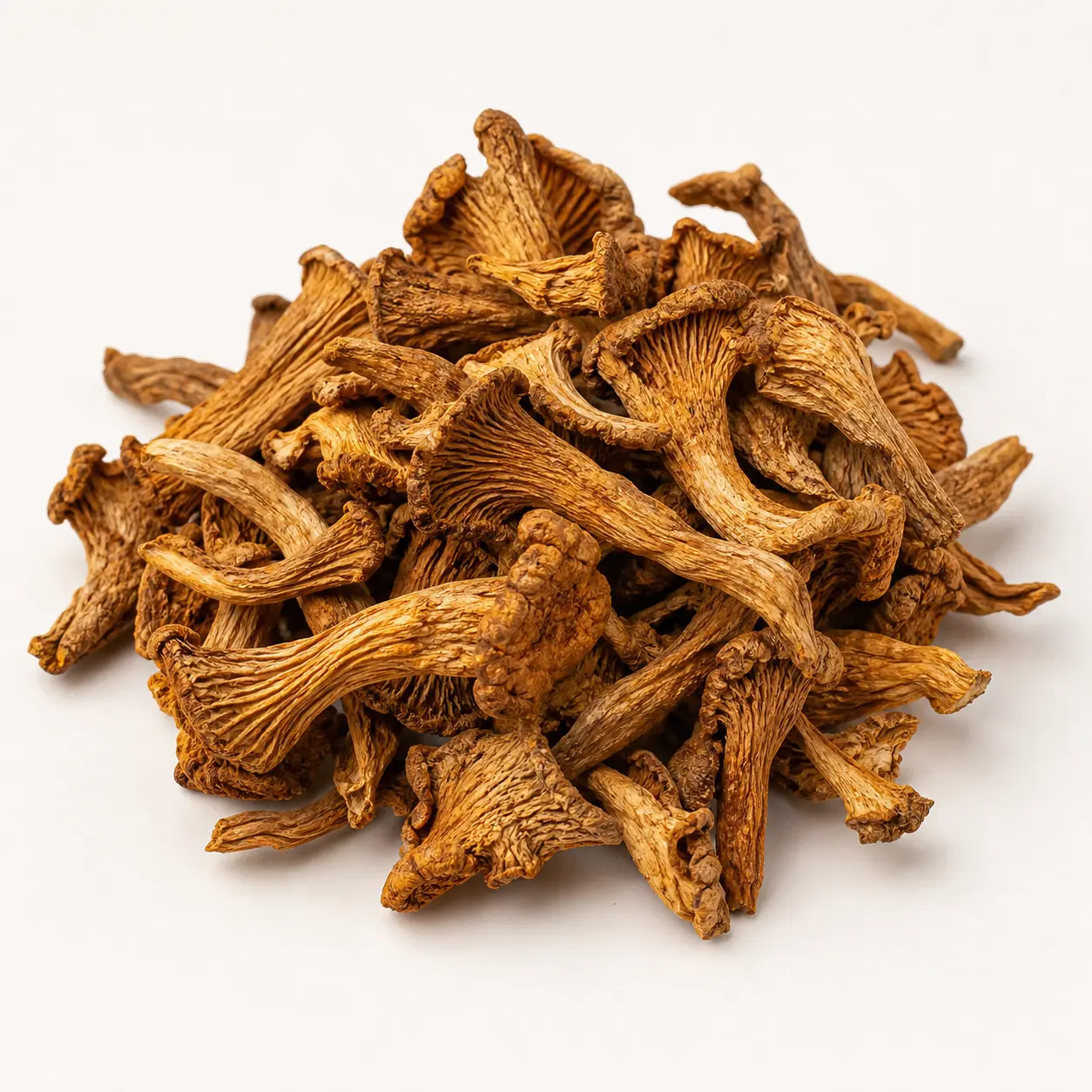
Chanterelle Mushroom
High-quality dried chanterelle mushrooms with strong price advantage for bulk buyers.
Wholesale price
$30.54/lb
$67.32/kg
Market reference
Approx. $176/kg
Need wholesale support?
Contact Fungi Origin for pricing, product inspection, pickup, GTA delivery, or courier shipping across Canada and the US for bulk dried mushroom orders.
Contact Us